Continuing the Previous Part Prove That the Scheme is Unbrekable

Wow, this is embarrassing. While we all took an extended hiatus from this blog,two more parts of one of my favourite animes were released. Fully. It's time to right the wrong and start reviewing them!
My last two reviews were Stardust Crusaders, the part that failed to deliver in the story department but had amazing sights and sounds that made it a blast to watch regardless. Before that was Battle Tendency, which I felt was just overall… better. And long ago I reviewed Phantom Blood, JoJo's relatively mediocre beginning, but something that set the stage for all the amazingness to come.
Now we arrive at Part 4. Will it dethrone Part 2 as the greatest part so far? Or will it bite the dust and fail to deliver? Read on!
Diamond is Unbreakable breaks the 50-year timeskip tradition, and is set only ten years after Stardust Crusaders. Jotaro Kujo, now dressed in white for some reason, is investigating some weird occurrences in the town of Morioh that are likely the work of an enemy Stand.
He's also looking for a high school student by the name of Josuke Higashikata, who is the main character of the part.
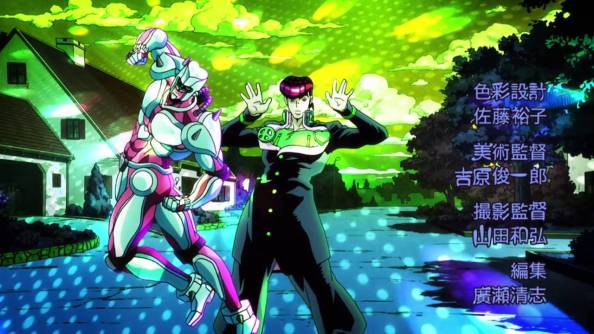
JoJo is fabulous again!
Josuke is a JoJo, in both name (I guess Higashikata has a 'Jo' in it, if you read it in Japanese the right way) and in bloodline. You see, Josuke's father is none other than – Joseph Joestar? What?
Yes, apparently Joseph cheated on his wife. With a 20-year-old woman. While he himself was 65. This never really sat right with me. In Part 2, Joseph showed some signs of being a womanizer (an unsuccessful one), but I never got the impression from his character that he'd cheat on his wife. Part 3 showed him as much more mature and honourable than his Part 2 self, and yet, at some point just before Part 3, he had an illegitimate kid that he never knew about.
It's a kick to Joseph's character – a pretty harsh one following his lame Stand and useless Ripple in Part 3.
I don't think I'll everlike this plot thread, but I do begrudgingly ignore it. Jotaro is only 28, so it's impractical for him to have a child who's old enough to be a protagonist.

Yet.
With that in mind, there aren't really a lot of other options for a new Joestar. As far as we knew up til now, every Joestar was an only child. Making Joseph cheat on his wife was pretty much the only way we could get a Joestar who's at this age.
Besides, Joseph was the best JoJo, and he passes on a lot of his greatest qualities to Josuke. Following the rule where each JoJo is wildly different from the last, Josuke actually shows emotions. You see him smile, laugh and cry in situations where Jotaro would have scowled, scowled and scowled. But what's even better than Josuke showing emotions is that he showsweakness.
Admittedly, many of the times Josuke is vulnerable are times that really don't matter in the grand scheme of things. We see him drop his expensive shoes in a puddle and get suckered into cleaning a kitchen, and obviously neither of those things impact the plot. But they make Josuke feelhuman. This is a character who isn't perfect, and the Universe never bends over backwards to pretend he is. Though he's a mostly-competent character, the Universe is more than willing to kick Josuke for a cheap joke. This makes him the most relatable JoJo by far.
Jonathan was a paragon of virtue – he felt like a legend. Joseph was able to perform inhumanly audacious stunts in the blink of an eye – he felt like a cartoon character. Jotaro stood with his hands in his pockets and watched his overpowered Stand win all his battles for him – he felt like a power fantasy.
Josuke feels like a real human being that you could call up and hang out with, and it's part of what makes Part 4 so good.

Try to imagine Jotaro doing this. Just try.
The second main character to be introduced is Koichi Hirose, and he also does something wonderful that JoJo's Bizarre Adventure needed. He grows. Koichi starts off as an absolute nobody, to the point where he doesn't even have a Stand. In his first introduction to Stands, he's an ordinary human being trying to comprehend the invisible battle taking place in front of him. It's a viewpoint that's easy to forget when every other character is a Stand User, so I'm glad to see it when it happens.
One of the first story arcs involves Josuke and Koichi encountering a Stand Arrow – a weapon that can grant Stands to whoever is shot by it, assuming they have the willpower to control it. Koichi gets shot by the arrow, and what's brilliant to me is that hedoesn't have the willpower to control a Stand. Not yet. The only reason Koichi survives the arrow is because Josuke cheats, using his own Stand [Crazy Diamond] to heal him.
Koichi is rewarded with an incomplete Stand, and over the course of the series, he's constantly thrust into more and more Stand battles. These battles push his Stand [Echoes] to evolve from a useless egg into a fully-functional Stand with its own nonsensical powers. At the same time, we see Koichi evolve as a person, growing from a timid little kid into a tiny little badass. By the time Echoes reaches its final form, every character and viewer has Koichi's respect.

Pretty sure that's the correct subtitle.
The third main character is Okuyasu Nijimura. Once an enemy, Okuyasu becomes Josuke's best friend and most reliable brawl buddy. He's also a pretty solid character. His shtick is that his Stand [The Hand] is absurdly powerful, and in any other JoJo character's hands, would be near unstoppable. However, Okuyasu is pretty dumb, reckless, and doesn't have much faith in his ability to make his own decisions.
Over the course of the series, Okuyasu… doesn't change that much. He gets a little more faith in his own decision-making, but he still doesn't use his Stand to its full potential and he's still pretty dumb. In the end, Okuyasu really isn't abad character, but his character arc isn't nearly as compelling or as well-done as Koichi's, and it's a shame that Okuyasu is normally the one backing up Josuke.

Okuyasu is so thoroughly in the back here he almost fades into the background. Huh. There's almost a metaphor there.
The fourth and final lead character is Jotaro, who takes a much more passive role in this part. To the other protagonists, Jotaro is a mentor. He uses his knowledge from Part 3 and beyond to explain different types of Stands and make assumptions about their powers, while mostly hanging out in the background conducting off-screen investigations.
This lack of focus does wonders for Jotaro as a character. He's rarely the one to actually resolve a problem; he simply passes on information. Jotaro even picks up his first real character flaw. His antisocial nature is ramped up from a "badass" character trait to something with consequences. One fight has Koichi and Jotaro fighting a Stand together, and Koichi is so frustrated with Jotaro's refusal to communicate properly that Koichi thinks Jotaro has no faith in him, and makes a risky move that backfires terribly. Koichi takes a big part of the blame, but this sort of thing would not have happened if Kakyoin or Avdol were in Jotaro's place!
To the antagonists, Jotaro is a huge obstacle. It's common knowledge (somehow) that Star Platinum can stop time and is incredibly powerful, so every minor villain needs to find some way to avoid Jotaro getting involved. This helps avoid the Part 3 problem where Star Platinum was the solution to every crisis.

He also wears white now. It does not look very good with his hair. Just roll with it.
This cast of four is rounded out with the occasional side character, making for a fairly respectable set of characters. Next question – what does this well-constructed castdo?
The plot of Part 4 is strange, to say the least. At the start of the series, Jotaro's goal is to find the Stand Arrow, and Josuke's goal is to protect the town – by finding the Stand Arrow. This is a cool plot, but it's not really handled very well. Many of the early episodes revolve around fighting evil people who gained Stands from the arrow, without making any real progress towards finding the arrow itself. Finally, about a third of the way into the series, the guy who owns the arrow reveals himself, the crew defeat him, and the Stand Arrow plot peters out.
With nothing really left for the characters to do, there are a few episodes of the old defeated villains becoming side characters exploring new mysteries and other leftover Stand Users. This gives these weekly villains much more depth than the ones in Part 3 and makes the setting feel much more real, but it wouldn't be enough to keep the show going for the rest of its part.
Luckily, one of these episodes leads into a second plot – there's a serial killer lurking in Morioh. It's a little odd to have a second "big bad" in one part, and I think David Productions understood this, because the anime adds in some early foreshadowing that wasn't in the manga. Either way, this serial killer arc is incredible simply because of the strong writing behind the characterization of the serial killer himself. Introducing: Yoshikage Kira.

This friendly fella.
In the same way that Josuke is relatable and entertaining because he feels like he could exist in a town just like yours, Kira is disturbing and terrifying because he alsofeels like he could exist in a town just like yours. Whereas Dio and Kars had unrealistic, cartoonish goals like ruling over humanity and ascending to godhood, Kira's goal is simpler. He wants to live a quiet life. He wants to be completely unnoticed by society, another face in the crowd, so that no one would ever suspect him of the countless murders he commits.
Kira is used a lot better than Dio was in Part 3. Dio sat around doing nothing for 50-odd episodes, but not Kira. Kira has a few episodes devoted to himself and his situation, as if he were the main character. These give a brilliant insight into the kind of person he is and how he feels while he's committing his crimes. It only takes one of these episodes to get to know Kira better than we got to know Dio. Better yet, Kira has a couple early interactions with the protagonists. Through these, the conflict between Kira and Josuke becomes more personal than the conflict between Jotaro and Dio, who didn't even meet until their final battle.
The Kira-centric episodes also show that Kira hasweaknesses, something that Part 3 sort of forgot to do with Dio. However effective Kira is, he's only human, and his Stand is actually less powerful than Star Platinum or Crazy Diamond. Dio and Kars were both egotistical and so powerful that their egos were deserved. Kira goes in the complete opposite direction, and is a much better character for it.

That hand isn't attached to anything, by the way. Kira's creepy.
In between the Kira-focused episodes, there are – for better or worse – more Stand-of-the-week battles. As before, these drag down the plot a little; things aren't quite as tightly knit as Part 2's story. It can be irritating to interrupt the Kira plot with a Stand battle you don't really care about.
That said, the weekly Stand battles are handled much better than Part 3. I already mentioned how some of these minor characters return after their initial defeat. Even the ones that don't are fun to watch, though. This is because Araki has embraced the 'Bizarre' part of the title even further.
Stands in Diamond is Unbreakable are so wild and crazy that you almost forget that 'being a car' counted as a power in Part 3. I'd start listing them, but it's way more fun to experience the Stands' wackiness without any spoilers. I'll give one away as an example – one Stand can transform objects into folded pieces of paper. It can also do this to people, butonly if the user sees a physical manifestation of the target's feartwice. It sounds stupid, but it's such a great fight.

NANI indeed.
There are also episodes that change up the "characters encounter enemy Stand user" formula completely. Several of the weekly Stand users aren't evil or even enemies, and getting rid of that part of the formula lets the stories vary much more than they did in Part 3.
With that, we've covered the characters and plot. There isn't tons to talk about in regards to Diamond is Unbreakable's setting. Unlike all three Parts before it, Diamond is Unbreakable is set in a single location – the town of Morioh. It's a simple, fictional, Japanese city without much to say about it. The big advantage of setting a story in a single city is that it allows the minor characters an excuse to reappear. Characters can just wander around and walk into each other.
On the other hand, Parts 2 and 3 gave us a tour around some really interesting real-world locations. It's cool to track the Crusaders' journey from Japan through Hong Kong, Singapore, India, etc., especially with the narrator chiming in to bring up some interesting true trivia. The backdrops were also varied and beautiful.
With Morioh not actually existing, we don't get any of that, but it still feels like a real – albeit paranormal – town. The narrator even brings up key Morioh landmarks in the same way he explained Tiger Balm Garden in Hong Kong. These moments add some fun charm to the city.
One weird thing, though. Morioh has a yellow sky. All the time. Its foliage is also normally purple. This is obviously a stylistic choice (no one ever comments on it) but it's odd to me that this is a constant thing. Up til now, JoJo has presented tense scenes with drastic colour changes, but in Part 4, the background is constantly in a state of absurd colours. The best explanation I've heard for this is that Morioh issupposed to be constantly tense. It's a weird town full of weird people – particularly the mass murderer I mentioned earlier. There's something wrong with the town, and the bizarre colours are a metaphor for it.
I don't know if I completely buy that explanation, but heck. It works.

See what I mean about Jotaro's hair?
Speaking of Part 4's artstyle, let's talk about Part 4's artstyle. (My Stand has the ability to write flawless segues.)
From Part 1 to Part 3, the art in JoJo improved drastically – and it didn't even start off that bad! Part 1 was a delight to look at, with bright visuals and character designs much more detailed than a typical anime. Part 2 improved on it by refining the details and pumping up the drastic colour changes to even more ridiculous lengths. Part 3 threw in a bit more CGI and just took more time fine-tuning all the details.
If I had to point out a flaw in Part 3's artstyle, it would be in the animation. Sometimes, characters felt stiff, like they were trying to avoid moving their entire bodies. Part 4 is a lot better about this – characters move much more fluidly, and much more often. However, this all comes with a price.
Overall, characters look a lot less detailed and frankly, worse. Sometimes, characters in the background have no eyes. This happened in Part 3 once or twice, but there, it was a stylistic choice to show a threat. Here, it feels like it's just to save time. There are even some frames and clips spread around as "QUALITY" memes, which is sad to see for a series that has had such incredible art and animation throughout.

No, Koichi does not move at all in this shot and it stays on the screen for long enough to notice.
However, the really bad moments are few and far between. Overall, the visuals live up to Part 4's predecessors, and some of the better moments go beyond anything Parts 1-3 had.
One nifty change is that every Stand user gets an aura when their Stand is active. It's a nice visual cue and helps add some motion to some shots that would otherwise be too still.
Another fun addition is an increase in fancy transitions and unusual split screens. These took me a bit of getting used to, but they continue through Part 5 and it quickly starts to feel like a JoJo tradition.

Notice how the split screens are now put directly onto the current frame instead of actually… splitting the screen. A very nifty visual.
As for the music and sound, Part 4 exceeds Part 3, and Part 3 set a high bar. Most if not all of the minor Stand-of-the-week villains have unique background music. Like the second half of Part 3, the music is perfectly thematic, but things have started to go a little beyond. One fight takes place in a radio tower (seriously) and the music includes a percussion section that sounds like someone's hitting a resonating metal tower with a hammer.
At this point in writing this article, I went back to my Part 3 reviews to see what else I should cover, and was reminded about one of my least-favourite parts of Stardust Crusaders – the gross-out humour.
In Part 4, this is all heavily toned down. There are a few moments that make me shake my head, but they're much rarer than in Part 3. Diamond is Unbreakable does have a few uncomfortable / gross moments, but these are generally played forhorror over humour. It's much more effective, in my opinion.
Animal violence is toned down too. …Sort of. Anyone reading this review would think I'm a liar after one of the early episodes, which features one of the most unnecessarily brutal animal deaths in all of JoJo. But besides that one, things are mostly better. At the very least, when an animal dies in Diamond is Unbreakable, there's typically a better reason for it than pure shock value. …Except that first one.
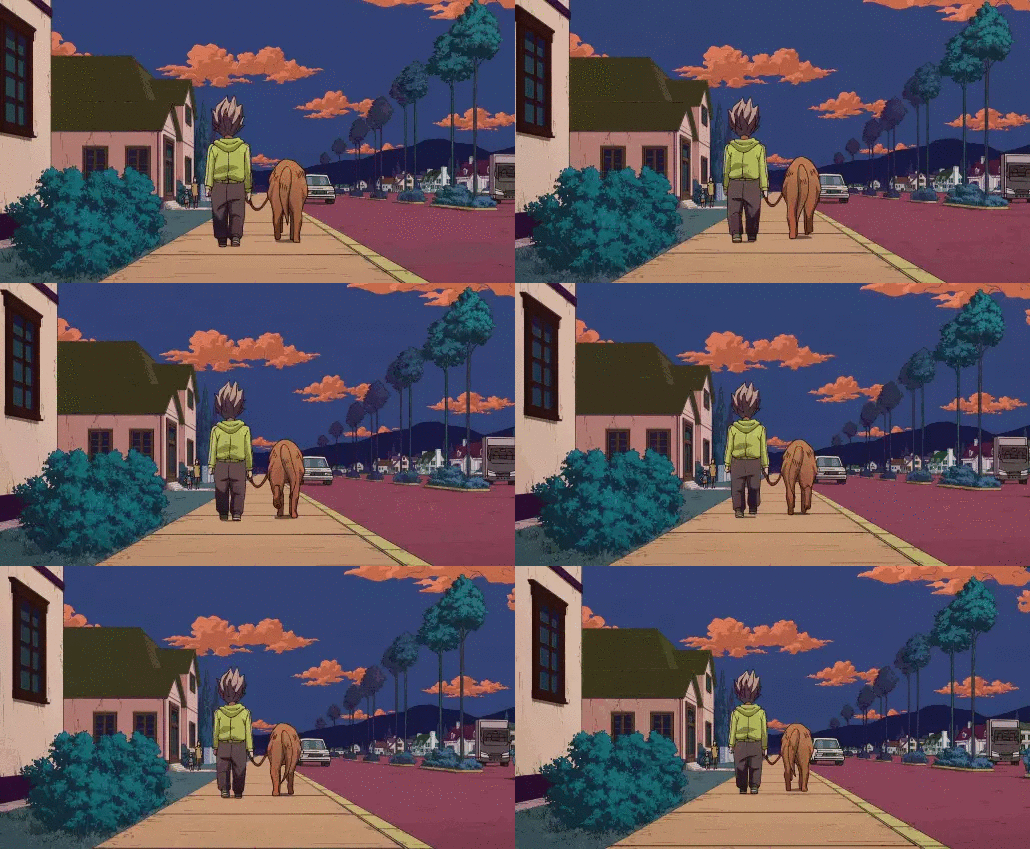
Koichi's dog even makesmultiple appearances without dying!
With that, I think I can safely wrap up this review. "But wait," you might be saying. "What about Part 4's flaws? The only one you really brought up was that the one-off Stand users interrupt the main story, and you went on to say that they're still pretty interesting. So what are Part 4's weaknesses, you handsome reviewer you?"
Honestly, that's about it. Part 4 is fantastic – some of the best that JoJo has to offer. It's really a toss-up between whether I rank it just above or just under Part 2. Because of that, it earns a solid9/10, just like most things I review.
With the previous four JoJo parts, I gave an even more arbitrary score for the manga. Part 4 has, I would say, more differences between the anime and the manga. A few scenes are shortened, some are extended or added, and three mini-arcs near the end of the series are collapsed into one. Also, the occasional poorly-drawn piece of art in the anime can spoil a good scene, but the manga's art quality is more consistent.
However, the style changes drastically – Josuke looks a lot more like a Part 3 character at the start of the series before Araki slowly transitions into drawing skinnier characters. A couple one-shot characters morph appearances too, starting out rather tall before shrinking down to Koichi's tiny height. It's a strange difference.
Either way, the anime is a solid watch and the manga is a solid read. Starting with this review, I'll stop rating them separately and simply tell you to check out Diamond is Unbreakable in whatever form you want.
Killer Queen has already touched this review.
tedeschifittold00.blogspot.com
Source: https://cynicscapeblog.wordpress.com/2019/11/14/tesla-reviews-jojos-bizarre-adventure-part-4-diamond-is-unbreakable/
0 Response to "Continuing the Previous Part Prove That the Scheme is Unbrekable"
Post a Comment